Showing posts with label CLIL. Show all posts

07 December, 2017

Ancient Egypt II

In Autumn 2 our spiral topic at Sudbury was "Back in time". Year 3 learnt about Ancient Egypt in class and we learnt about it in our French lessons too.

This year we learnt the names of some Egyptian Gods and also talked about hieroglyphs. The children introduced an Egyptian God writing his name in hieroglyphs. 


We also looked at the different types of buildings in Ancient Egypt and learn how to form the plural in French.


The Year 3 children were very brave to learn a history topic in French! They are amazing at decoding the language and understanding the French language in context! 


12 June, 2017

Les Amérindiens - Native Americans

Two years ago I found a beautiful book about a Native American in one of my travels to Lille.

I thought I could use it when Year 3s learn about the Americas and I couldn´t resist to buy it.

I hadn´t used the book yet, but last term, I finally planned some activities to teach a unit on Les Amérindiens.

We first located Les Amérindiens in the frise historique or time line, located them in the map and learnt about how they used to live.


We practised listening to the French words related to their way of life and customs while playing bingo.

We also learnt an authentic song about un petit indien called Nagawika. This is a song that French children learn at school!


un petit indien nagawika (officiel audio and... by dm_51a0a978942d1

Finally, we read Heyo and learnt some frequency verbs. The story has some repetition (Je suis Heyo, un Lakota; je suis un bon chasseur, je suis un bon cavalier; je suis un bon pisteur) so it works really well to introduce the form Je suis + adjective.


The children created beautiful minibooks about Heyo, we hope you like them!


Next year we will also learn the story of the Native American Pocahontas.

03 June, 2017

Activities around Japan

In Summer 1, the whole school topic was "Countries Project". Each year group focused on a continent and each of the classes studied a country on that continent.

This is one of my favourite topics, as you can be so creative with your planning. I also like "Countries project" because the last day of the half term we celebrate "Travelling week" at Sudbury and we get to go to different classrooms and learn about a lot of countries. There is a presentation, a performance, activities and crafts and even food!

Year 4 focused on Asia and I decided to plan a series of activities around Japan.

We listened to the song "Le petit japonais"and practise our listening skills indentifying some vocabulary.


Find the song in this book CD on Amazon


We also learnt some facts about Japan. I used a fantastic book that I found in Paris two years ago.


I planned a carrousel activity where the children, in groups, had to read a short paragraph in each station and use their language skills to understand information about the typical dish, sports, greetings, clothes etc. Some children even translated the text into English!


On the following lesson, we created minibooks with all the facts that we learnt about Japan.


22 January, 2017

Decoding skills

In Spring 1 all the year groups are learning about environment in class. We have linked our language lessons to the topic of each year group and we have just started with our subject lessons taught in French.

In the CLIL lessons, the pupils are using the language in a meaningful context, which makes them incredibly motivated and interested in the lessons. Because they are studying the same topic, the children can make connections and they consolidate their learning. 

This week we have been discussing language learning strategies and more specifically, decoding skills: how can you guess the meaning of new words? what helps you decode new vocabulary and in this case, scientific vocabulary?


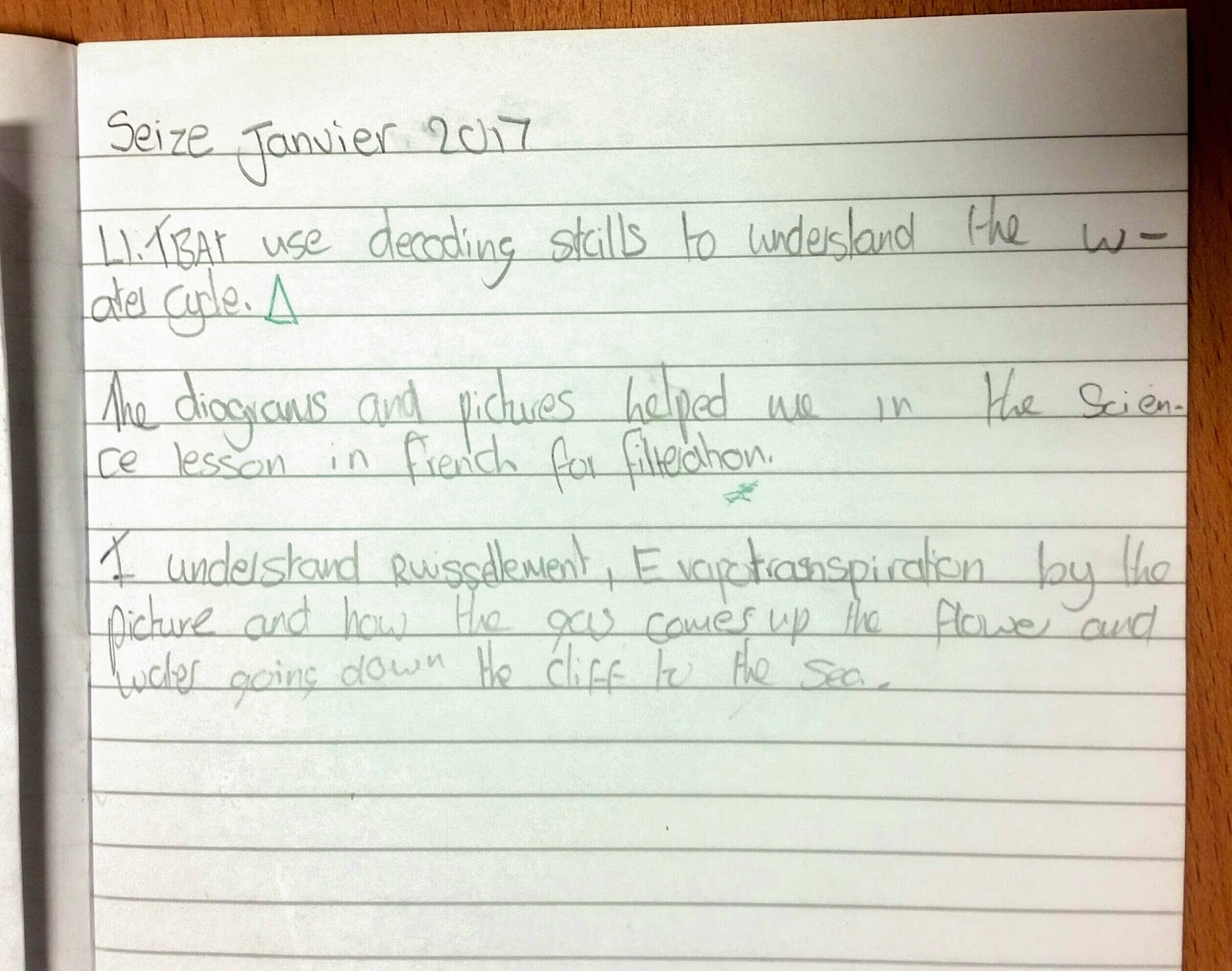
Year 6 watched an authentic video about the water cycle where the different stages are explained and the name of each is displayed in French. Most of the names of the stages are cognates, but the children had to guess the meaning of ruissellement and évapotranspiration; they also had to reflect on how their decoding skills helped them to know these scientific words.


Year 3 have been learning the names of recyclable materials in French. Then, they watched this episode of Peppa Pig.


I stopped the episode when the mum explains what you put in each of the recycling bins (poubelles de recyclage) and they had understood very well, even if there were new words that they didn´t know, like journaux, bouteilles, etc. Then, I stopped the video when Peppa and his family go to the recycling centre (la déchetterie) and they fed back to me what was happening in the episode.
When I asked the children how could they understand a whole cartoon in French they told me that they could understand because of my actions, the images and recognising familiar vocabulary in the video, like the colours and the names of the recycling materials they had just learnt.

Year 4 have started learning about the different types of pollution. This year they are not learning this in class, so I had to show them some pictures, explain the type of pollution in French and do some actions to reinforce my explanations. In pairs, I asked the children to tell their partner what was happening in the picture and how they would say in in English. In a CLIL lesson, we can move from the target language to English to check the pupils understanding and then go back to teach in the target language.


After understanding each type of pollution and translating it in English, I asked the children to compare the French and English forms and tell me what they noticed about the order of the phrases. This may be obvious for us, language teachers and linguists, but our pupils need to reflect on how language works to acquire language skills that they will be able to use when they go to secondary school and in the future.

These were just the first lessons of the unit and the following lessons the vocabulary will be more complex, the children will learn new grammar concepts and structures and they will manipulate language independently.

It is true that CLIL lessons are cognitively more demanding, and the thinking skills are higher as pupils are not just learning and remembering new vocabulary, but they are analysing, reasoning and putting the language into context. The children love the challenge, they enjoy deconding and using context clues to access meaning.

As a teacher, I really enjoy teaching French lessons linked to Science, History and Geography and I believe that learning structures and specific vocabulary through CLIL can provide a valuable platform for progression. Planning these lessons involves researching for quite a few authentic materials and the resources have to be created from scratch, but I think it is worth it after noticing the fantastic motivation and progression of the pupils.


03 December, 2016

Healthy eating

Year 5 have been learning about food this term.
Our French buddy Toto, told them about some typical French food. Have you tried any of this food?
Qu'est-ce que tu aimes manger? 
Qu'est-ce que tu n'aimes pas?


We looked at some items of food and decided if they were healthy or unhealthy. Then, we extended our sentences saying why.


We also looked at the food pyramid and learnt the names of the different groups of food in French.


The children read an authentic advert and answered some questions in English. They were encouraged to look at context clues to understand the text.


Finally, we created our own healthy meal including some fromage et crudités!


20 May, 2016

Un peu de géographie

In Summer 1, our school topic is Countries project and geography. Each year group learns about a continent and each class has focused in one country of that continent.

Year 5 have been looking at maps and learning specific vocabulary in French, linking our objectives with the NC objectives for geography "use maps, locate countries, use compass points, build your knowledge about the wider world, identify Equator, Northern Hemisphere, Southern Hemisphere, the Tropics of Cancer and Capricorn".

First, we located les pays, les continents et les lignes imaginaires.


Then, we completed some sentences looking at maps and using the new vocabulary.


Click on the white dots to listen to the children.

Year 5 then had some lessons about Africa, as it is the continent they are learning about in class. Watch this space to see the activities we did in French!

Localiser les continents

Où se trouve...? 

Faire glisser: continents et océans

02 May, 2016

La seconde guerre mondiale

Last term the Year 4s were learning about WWII in class, so I decided to teach them about WWII in France.

We first looked at the countries of les forces de l'axe et les forces alliées and their leaders; we then practised Je m'appelle + name of leader, Je suis + nationality.


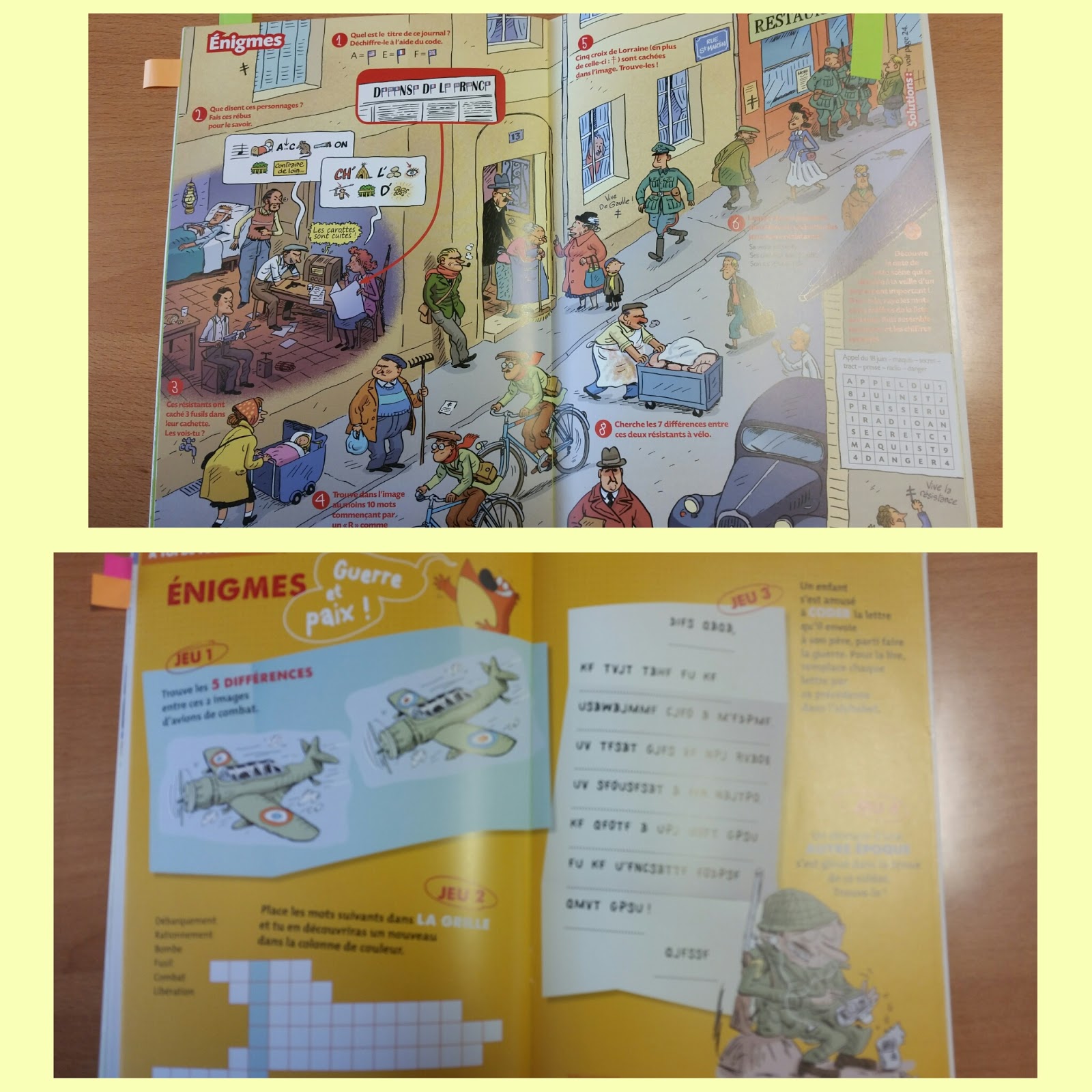
After that, we learnt about De Gaulle's speech in the BBC, the resistance and the main events of WWII in France.


Finally, we watched an episode of the French series Les grandes, grandes vacances to learn about the French evacuation l'exode and answered some comprehension questions about the cartoon.


Learning about the class topic in French makes our lessons meaningful and more interesting. The children were really engaged and they loved learning about WWII in France. Look at some of their feedback messages!


04 March, 2016

World Book Day 2016

Yesterday was World Book Day at school and we also wanted to celebrate it in our French lessons.

Year 2 read Petit poisson blanc. They enjoyed doing actions for each of the sea creatures and joining with repetition everytime I asked them C'est la maman de petit poisson blanc? They also created their own version of the book, which they proudly took home to read to their parents!


Year 3 read Vive les livres. They learned the names of the different types of books and then in pairs, children had to come up with an action and a different voice for each type of book. It was a lot of fun to watch their fabulous performances!


Year 5 read J'aime les livres and looked at the types of books too. They wrote about the type of books that they like and dislike and about their favourite book.


26 February, 2016

Le cycle de l'eau

As you know in Spring 1 all year groups were learning about environment and sustainability.
The topic for year 6 was rivers, so in French we learnt about the water cycle.

We started the topic with an authentic clip. The children had to guess the learning objective of the lesson. The voice in the video has not been slowed down, but the images correspond to the water cycle and the key vocabulary is displayed.


Then, children learnt the scientific names of the states of matter in French and did a writing activity on the change of state.


We also read an animated text from a the Belgian website la récrée where each of the stages were explained. Children had to use their decoding skills to understand the text. Then, they had to show they understood the text by putting some cards together in order to create sentences for each stage of the water cycle. 


At the end of the unit, children made their own posters of the water cycle. They labelled the stages, the state of matter and explained the process writing sentences and using time connectives.


The pupils enjoyed the unit thoroughly and demonstrated enthusiasm and a lot of interest in learning a science topic in French. They even said that learning the water cycle in French helped them to understand it better in English :)

These are some of the activities that we have done in class:

L'eau dans tous les états

Stages of the water cycle

Le cycle de l'eau en séquences

Parcours de l'eau minérale

Léo et l'eau

5 aventures de Lola et Lolo

A case study on teaching about the water cycle through the medium of French, the resources of the full unit and a video lesson will be published by the University of Westminster.